






Best Scaffold Towers to Hire for Plastering Work
Plastering is one of the most physically demanding working at height tasks. Unlike painting or inspection work where one hand can grip a guardrail for balance, plastering requires both hands free at all times. Your hawk carries the plaster. Your trowel applies it. Nothing else is available for steadying yourself. That makes platform stability more critical for plastering than almost any other trade working at height.
The right scaffold tower hire for plastering gives you a wide, stable platform at exactly the right height, with locked castors that don’t shift under the physical effort of trowel application, and enough deck space for your hawk, bucket, and tools within easy reach.
This guide covers the best scaffold towers to hire for plastering walls and ceilings, what height to specify for different job types, and how to work efficiently and safely from height.
Why Plastering Needs the Right Scaffold Tower
Plastering is one of the most physically demanding working at height tasks. Both hands stay on the hawk and trowel at all times, so the platform itself has to be completely stable.
Two-handed application puts constant lateral force on the tower as you rule off and flatten each coat. Any movement ruins the finish and risks a fall, so castor locking matters more here than on most jobs.
Materials add real weight too. A loaded hawk, plaster bucket, and tools can push platform load well past the operator’s own weight, so check SWL against your full kit. Plastering also means constant repositioning, often dozens of times a day. A tower that takes more than a minute to move slows the whole job down.
Understanding the types of scaffolds available helps identify which configurations provide the stability and platform size plastering demands.
Best Scaffold Towers to Hire for Plastering
The right tower depends on job type, ceiling height, and how much stability and deck space the work needs. Professional plasterers on large runs need a wide, rock-solid platform. DIY jobs need something quick to build and move. Stairwells and narrow hallways need purpose-built configurations. The five towers below cover all of it.
| Tower | Ceiling Height Suited | Crew Size | SWL | Best For |
|---|---|---|---|---|
| AGR Tower | Above 3m | Two-person | 275kg | Professional plasterers, large wall and ceiling areas, commercial plastering |
| Mi Tower | Up to 4m | Solo | 150kg | DIY plasterers, domestic bedrooms and living rooms, standard ceiling heights |
| Stair Tower | Variable | Solo | 150kg | Stairwell plastering, sloped ceilings above stairs, stair-adjacent surfaces |
| Narrow Scaffold Tower | 2.5-3.5m | Solo | 150kg | Narrow hallways, tight corridors, older properties with restricted dimensions |
| Room Mate Folding Tower | Up to 3.5m | Solo | 150kg | Multi-room domestic plastering, full house re-skims, repeated room-to-room moves |
AGR Tower: Best for Professional Plasterers on Wall and Ceiling Work
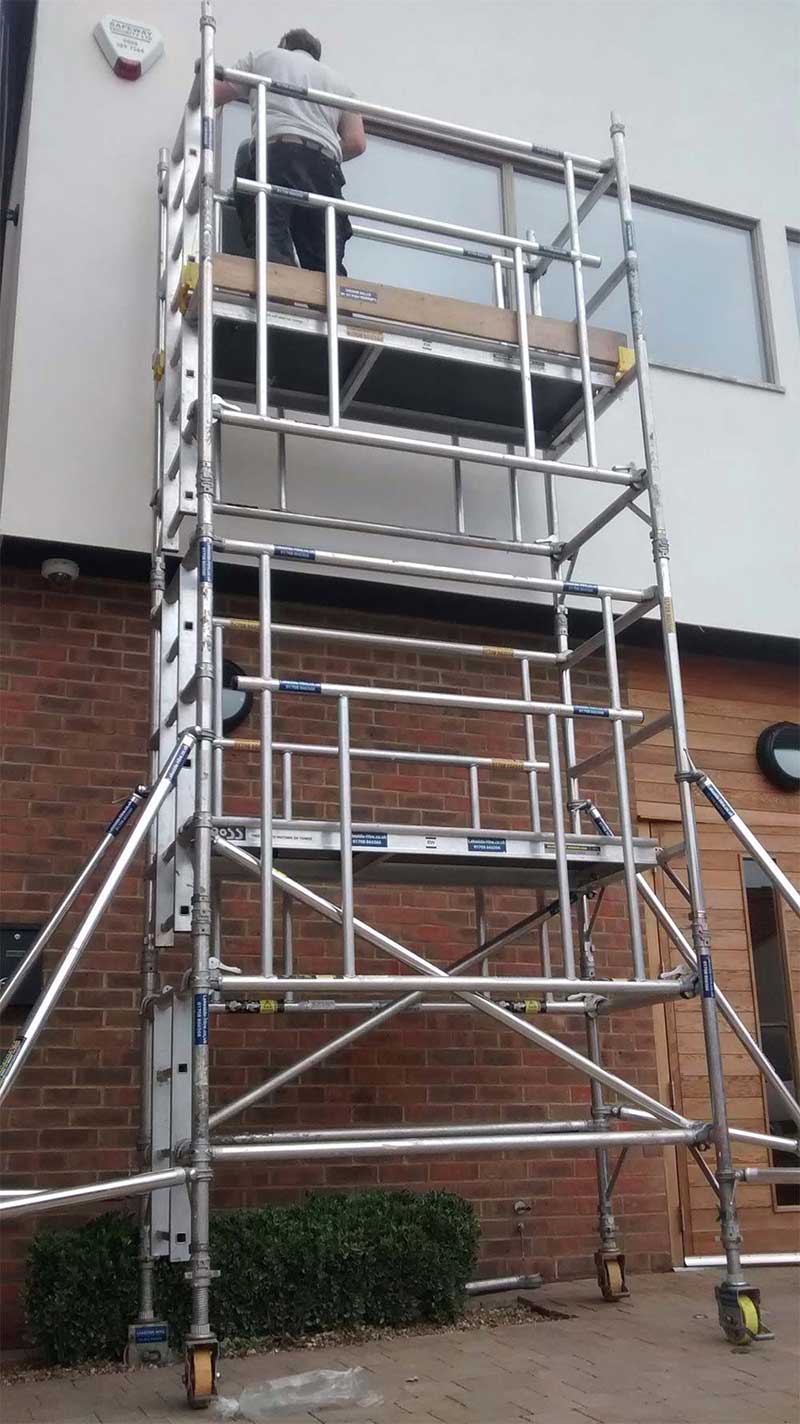
Professional plasterers working on commercial jobs, large domestic projects, and multi-storey wall runs need a tower that prioritises platform size and stability above everything else. The AGR tower delivers both.
AGR tower hire provides a double-width platform that gives a professional plasterer genuine working space. Your hawk bucket sits at one end of the platform. Your tools occupy the other. You work across the full deck width without the cramped, restricted movement that single-width platforms impose on two-handed plastering work.
The Advanced Guardrail system keeps guardrails in place throughout assembly. This matters for plastering specifically because you work hands-free for extended periods. Full guardrail coverage on all sides provides the passive protection that compensates for having no free hand available for balance during application.
The double-width platform also accommodates two plasterers on larger ceiling jobs. One applies while the other rules off and prepares the next section. This two-person rhythm significantly increases output on large ceiling areas in commercial environments.
Best for: Professional plasterers, large wall and ceiling areas, commercial plastering projects, two-person plastering crews working on ceilings above 3m.
Mi Tower: Best for DIY Plasterers on Standard Ceiling Heights
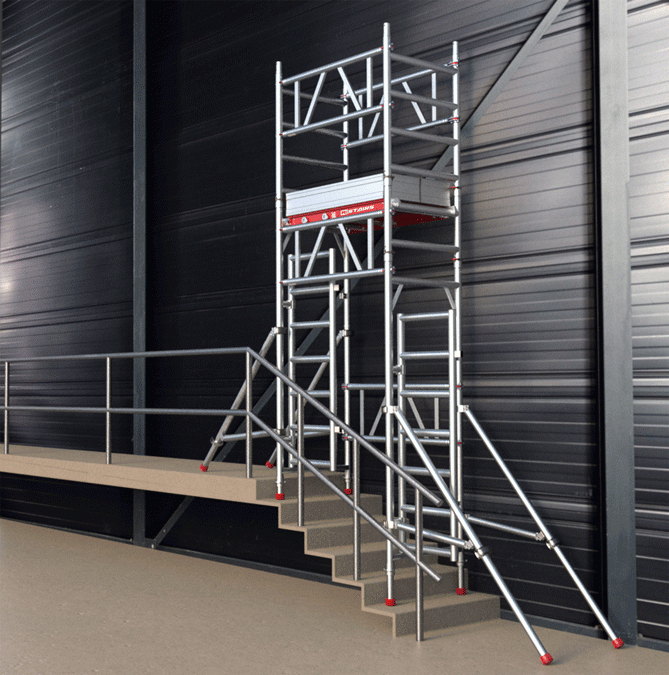
DIY plasterers tackling bedroom ceilings, kitchen walls, and standard domestic rooms need a tower that builds without assistance, repositions quickly between sections, and fits through doorways without dismantling.
Mi Tower hire suits domestic plastering at ceiling heights up to 4m. A single person builds it using a clip-frame system requiring no tools. Lockable castors allow rolling repositioning between wall sections without dismantling. The compact footprint navigates domestic rooms without moving furniture entirely.
For DIY plasterers, the Mi Tower provides a stable platform at manageable heights with enough deck space for hawk, bucket, and basic tools. The platform is narrower than the AGR double-width, so material organisation on the deck requires more care. Keep only immediately needed tools on the platform and pass additional materials up when required rather than loading the deck fully.
The Mi Tower suits first-coat and finish-coat application on domestic ceilings and high walls. For stairwells or rooms with ceiling heights above 4m, a different tower configuration is needed.
Best for: DIY plasterers, domestic bedrooms and living rooms, standard ceiling heights up to 4m, solo operators working between rooms.
Stair Tower: Best for Stairwell and Hallway Plastering
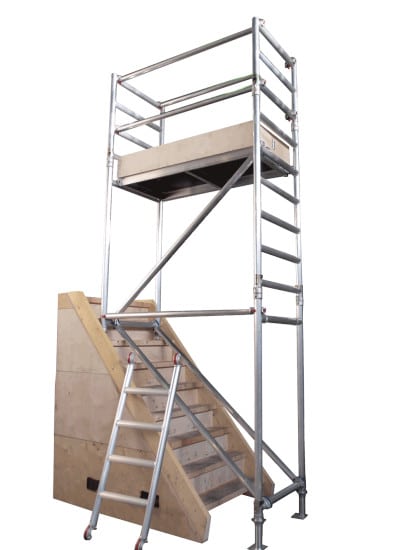
Stairwell plastering is one of the most hazardous working at height tasks in domestic renovation. The combination of sloped stair treads, varying ceiling heights across the stair run, and restricted width makes standard tower configurations unsafe. There is one correct solution.
Stair scaffold hire with independently adjustable legs provides the only safe working platform for stairwell plastering. Four independently adjustable legs with 300mm threaded shafts level the platform across the step between a landing and stair tread below. The platform sits level regardless of the stair angle beneath it.
Do not attempt stairwell plastering from a standard tower with fixed legs. Improvised levelling using timber packers or other materials creates unstable platforms that move under the physical effort of plaster application. The stair tower is specifically engineered for this environment and no other configuration provides equivalent safety.
Stairwell ceiling heights vary across the stair run as the structural ceiling follows the roofline above. Measure ceiling height at the lowest and highest points of your working area before specifying platform height. You may need to hire at two different platform heights for very long stair runs.
Best for: Stairwell plastering, sloped ceiling sections above stairs, any plastering work on surfaces adjacent to or above stair treads.
Narrow Scaffold Tower: Best for Corridors and Tight Hallways
Narrow domestic hallways present a different access challenge. Standard tower widths don’t fit hallway widths under 1.5m. Stabiliser spread on wider towers blocks the hallway entirely. Yet hallway plastering remains one of the most common domestic renovation tasks.
Narrow scaffold tower hire provides a 0.7m deck width that fits within tight hallway widths while still providing a stable working platform for wall plastering. For long hallway wall runs at heights of 2.5-3.5m, the narrow tower allows continuous working along the full hallway length without repositioning the entire setup for each wall section.
Check stabiliser spread against your hallway width before booking. Most narrow towers deploy outriggers that extend the base footprint to approximately 1.4m. You need clear hallway width of at least 1.4m for stable deployment. Narrower hallways require specialist advice before booking.
The narrow tower also suits plastering in older properties with non-standard room dimensions, utility rooms, and any internal space where standard tower widths create access problems.
Best for: Narrow domestic hallways, tight corridor plastering, older properties with restricted internal dimensions, any plastering run where standard tower width doesn’t fit.
Room Mate Folding Tower: Best for Multi-Room Domestic Plastering
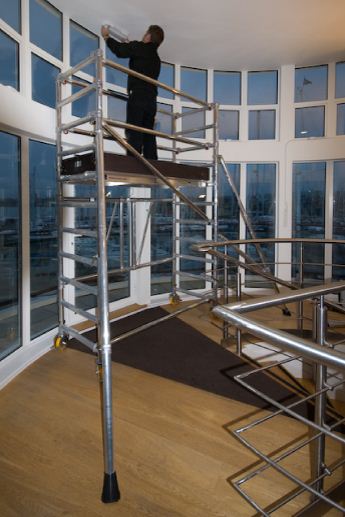
Plasterers working across multiple rooms in a single property face a repetitive access challenge. Moving a standard tower between rooms involves partial dismantling to pass through doorways, reassembly in each new room, and significant time lost to equipment handling rather than plastering.
Indoor scaffolding hire using the Room Mate folding tower eliminates this problem. The tower folds to pass through standard UK doorways without any dismantling. You fold it, wheel it through the door, unfold it in the next room, and resume work. The process takes under two minutes compared to 15-20 minutes for full dismantle and reassemble of a standard tower.
For plasterers working through a full house re-skim or multi-room renovation, this time saving compounds significantly across a project. A plasterer moving between six rooms during a working day saves over an hour compared to standard tower handling between rooms.
The Room Mate suits domestic ceiling heights up to 3.5m. For rooms with ceiling heights above this, a taller configuration is needed. Platform size is adequate for plastering tools but smaller than the AGR double-width. Organise your deck carefully with hawk position, bucket placement, and tool layout planned before stepping up.
Best for: Multi-room domestic plastering projects, properties where towers need moving between rooms repeatedly, full house re-skims, domestic renovation programmes across multiple spaces.
Key Features to Look for When Hiring for Plastering
Platform stability is the single most important feature for plastering. The physical effort of trowel application, ruling off, and feathering edges creates significant lateral force on the platform. Castors must lock firmly with no play. Any platform movement during application risks both finish quality and personal safety.
Double-width platform provides genuine working space for plastering materials. Single-width platforms work for DIY use at modest heights but restrict material organisation and body position during two-handed application.
Safe working load must accommodate plasterer plus all working materials. A plasterer with hawk, loaded plaster bucket, floats, rules, and feather edge boards easily reaches 200kg total platform load. Specify a tower with 275kg SWL minimum for professional use.
Toe boards on all sides prevent tools and materials dropping off the platform edge. A dropped hawk or float from height causes serious injury and damages finished flooring below.
Non-slip platform surface matters when plaster inevitably lands on the deck. Platforms with textured non-slip surfaces maintain grip even when wet with plaster splatter.
Check mobile tower scaffold maximum height regulations before specifying towers for tall commercial plastering environments.
What Height Tower Do You Need for Plastering?
Platform height for plastering differs from other working at height tasks. Rather than matching platform height to ceiling height, you need your platform at a height that puts the working wall area between chest and eye level. This is the optimal application position for consistent plaster coat thickness and finish quality.
Too high and you’re reaching down at an awkward angle, making it impossible to apply consistent pressure. Too low and you’re stretching upward, losing control of the trowel angle. The sweet spot is a platform height that puts the mid-point of your working wall section at approximately shoulder height.
| Job Type | Wall/Ceiling Height | Platform Height Needed |
|---|---|---|
| Single storey ceiling | 2.4m | 0.6-0.8m |
| High wall in two storey room | 3-4m | 1.2-2.2m |
| Two storey hallway | 4-5m | 2-3m |
| Commercial ceiling | 3-4.5m | 1.2-2.5m |
| Stairwell walls | Variable | Adjustable legs essential |
For ceiling plastering, your platform needs to sit at a height putting the ceiling at comfortable arm extension above you. Overreaching upward on ceiling plaster work causes rapid fatigue and inconsistent finish. Read the full guide on what size scaffold tower you need before specifying your hire.
Practical Tips for Plastering at Height
Set platform height carefully. Your working wall section mid-point should sit at approximately shoulder height. Take time to get this right before starting. Incorrect platform height causes fatigue within the first hour and compromises finish quality across the full wall area.
Lay plastic sheeting on the platform deck. Plaster drops on the platform make the deck slippery and difficult to clean between sessions. A plastic sheet catches the majority of falls and protects the hire company’s equipment from plaster build-up that can affect deposit returns.
Position all materials before stepping up. Hawk, bucket, floats, and rules should be on the platform and within reach before you start. Climbing up and down to retrieve forgotten tools wastes time and increases the number of ladder climbs per session.
Always lock all four castors before application. Check each castor individually rather than assuming. A single unlocked castor allows the tower to drift under trowel pressure on smooth floors.
Work in manageable sections. Apply plaster to a section you can rule off without repositioning, complete the ruling and feathering, then move the tower. Starting sections you can’t finish before the plaster sets wastes material and creates visible joins in the finished coat.
Cover finished flooring beneath the tower. Plaster drops from height penetrate carpet fibres and bond permanently to hard floor finishes. Dust sheets under and around the tower protect flooring that may already be finished by other trades.
How Much Does Tower Hire Cost for Plastering Projects?
Tower hire costs for plastering depend on tower type, ceiling height, and project duration. Standard aluminium towers for domestic plastering at ceiling heights up to 4m start from £33-74 per week. Commercial towers at greater heights run £89-132 per week.
Most domestic plastering projects run 1-5 days per property depending on scope. Weekly hire provides better value than daily rates for jobs exceeding three days. A full house re-skim across multiple rooms typically justifies a two-week hire at minimum. Long-term hire discounts of 50-70% apply on hires exceeding three weeks, making extended renovation programmes significantly more cost-effective.
Read the complete scaffold tower hire prices guide for a full breakdown of rates across tower types and hire durations.
Where to Hire Scaffold Towers for Plastering
Lakeside Hire delivers scaffold towers nationwide with next-day service to all major UK cities. PASMA-trained coordinators help specify the right tower for your plastering environment, working heights, and crew size before you book.
Next-day delivery reaches Manchester, Birmingham, Leeds, Liverpool, Bristol, Nottingham, and Leicester alongside full nationwide coverage. Zero deposit required with penalty-free early returns on all hires.
Frequently Asked Questions
What platform height do I need for ceiling plastering?
For a standard domestic ceiling at 2.4m, a platform height of 0.6-0.8m puts the ceiling at comfortable arm extension above you. Commercial ceilings at 3-4m need platform heights of 1.2-2.2m. Always set your platform so the ceiling sits roughly 300-400mm above your raised hands rather than at full arm extension.
Can I plaster from a ladder instead of a scaffold tower?
Ladders are not suitable for plastering. Two-handed trowel work requires both hands free for the full application duration, which is not safe from a ladder. A scaffold tower provides the stable hands-free platform that plastering requires and allows you to carry materials up alongside you rather than making repeated trips.
How long should I hire a tower for a plastering project?
A single room typically takes 1-2 days for first and finish coats. A full domestic property re-skim runs 1-2 weeks depending on room count and ceiling heights. Book for slightly longer than your estimate. Plastering timelines extend when coats need additional drying time before the next application, particularly in cold or damp conditions.
Conclusion
The right tower for plastering depends on job type, ceiling height, and working environment. Professional plasterers on large commercial and domestic jobs get the best results from AGR tower hire with its double-width platform and full guardrail coverage. DIY plasterers on standard domestic heights suit Mi Tower hire. Stairwells require stair scaffold hire with no alternative. Tight hallways need narrow scaffold tower hire. Multi-room projects move fastest with the Room Mate folding tower.
Get the specification right before you book. Lakeside Hire’s PASMA-trained team confirms the right tower for your plastering project before delivery. Call 01708 866566 or browse the full scaffold tower hire range with next-day delivery nationwide.


